

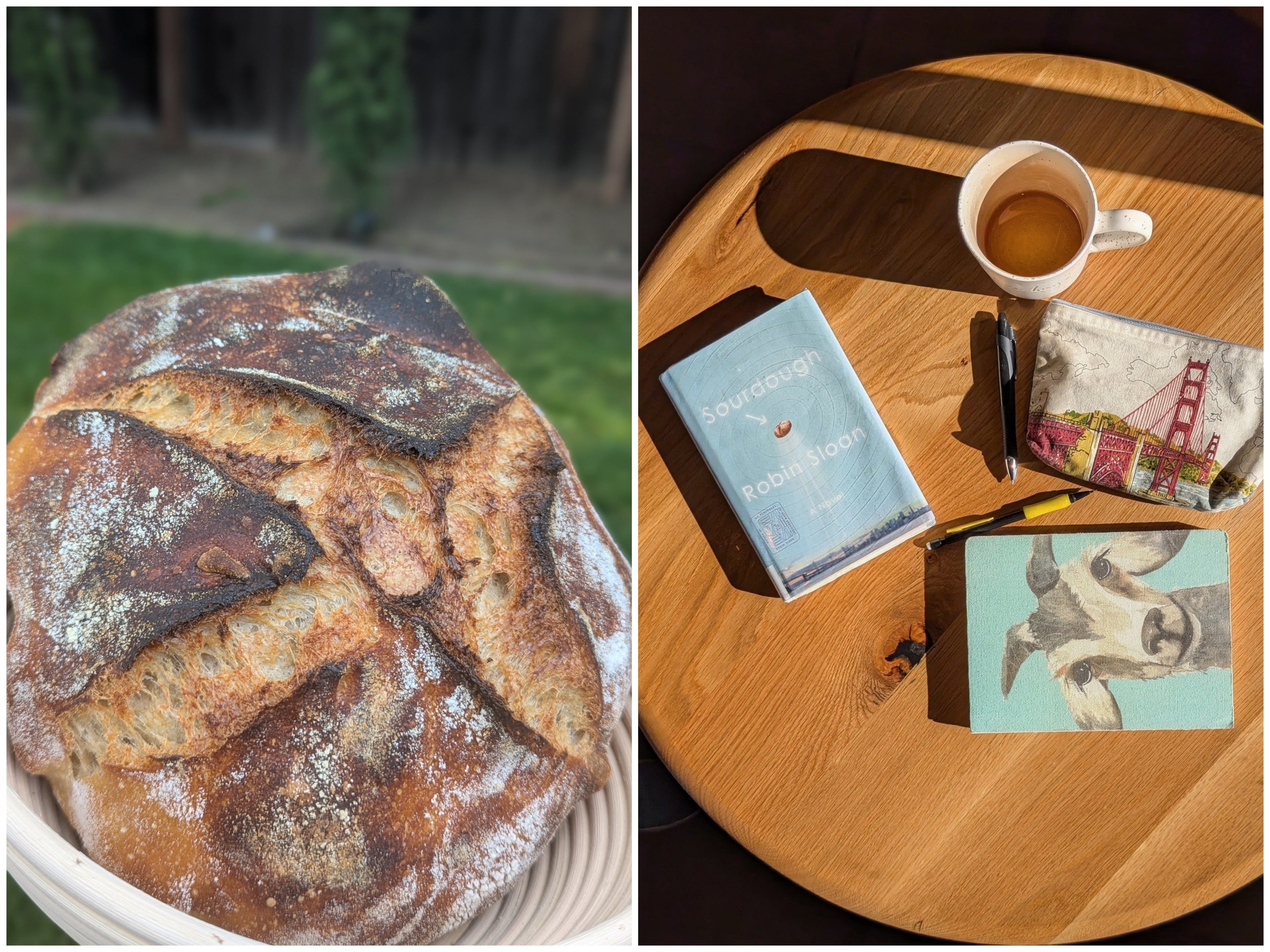
I picked up Robin Sloan’s Sourdough based on the recommendation of a Bay Area teacher who is also a fellow sourdough bread enthusiast. I could not imagine how an entire work of fiction could be created around the art of bread making, combined with a sci-fi plot set in San Francisco that captures so many aspects of Bay Area life.
The story revolves around Lois, a young software engineer who moves from the Midwest to work for a robotics company in San Francisco. While she is good at what she does, her true passion is ignited when she is handed a mysterious sourdough starter by two immigrant brothers. They run a local sandwich restaurant but have to leave the country due to visa issues. The brothers inspire her to become a full-time baker, but her success also pushes her onto an alternate path where she discovers the quirky side of San Francisco, where capitalism meets socialism in a very unique way. Here, she encounters a set of powerful, arguably well-intentioned, but clueless people attempting to build the future of the food industry through technology and obscure science experiments. Luckily, their ideas don’t come to fruition, as the science experiment fails, destroying the big plans carved around it.
The book starts on a promising note and carves out a plot that is highly unique, bringing together many themes in a way that is rarely executed successfully in modern writing. It sits at a unique intersection of modern sci-fi, culinary appreciation, and magical realism. At its heart, it is a story of self-discovery in a tech-driven world, complete with bread-making tutorials and a sharp portrayal of a Gen Z generation living in its own bubble. The book does a great job of portraying the unique culture of San Francisco, which feels incredibly real and close to home.
Sadly, the narrative loses its way in the middle and doesn’t fully recover by the end. The initial emotional connection—grounded in the existential dilemma we face while working in a tech company—suddenly shifts to a hypothetical sci-fi plot that becomes repetitive, abstract, and hard to follow. The ending is dull and leaves you craving more; what could have been amazing soon fizzles out.
This book is a great reminder where Sloan’s fiction mirrors our reality. The reality of what is happening in the food industry finds an uncanny resemblance in this plot and opens up many uncomfortable questions. The capitalist mindset of these well-intentioned but powerful people, combined with their half-baked knowledge, has far-reaching consequences. These individuals are so powerful that the world is left at the mercy of their self-obsession and half-baked ideas. Ultimately, the narrative they construct within their capitalist mindset ends up justifying every misstep.
Read this book for the sheer uniqueness of the premise. If you are a sourdough lover, seeing how deeply the author romanticizes the stages of baking will definitely bring a smile to your face.
Now I really want to read this book! It sounds like such an interesting mix of sourdough, food, and technology.