Life of Pie: Yann Martel
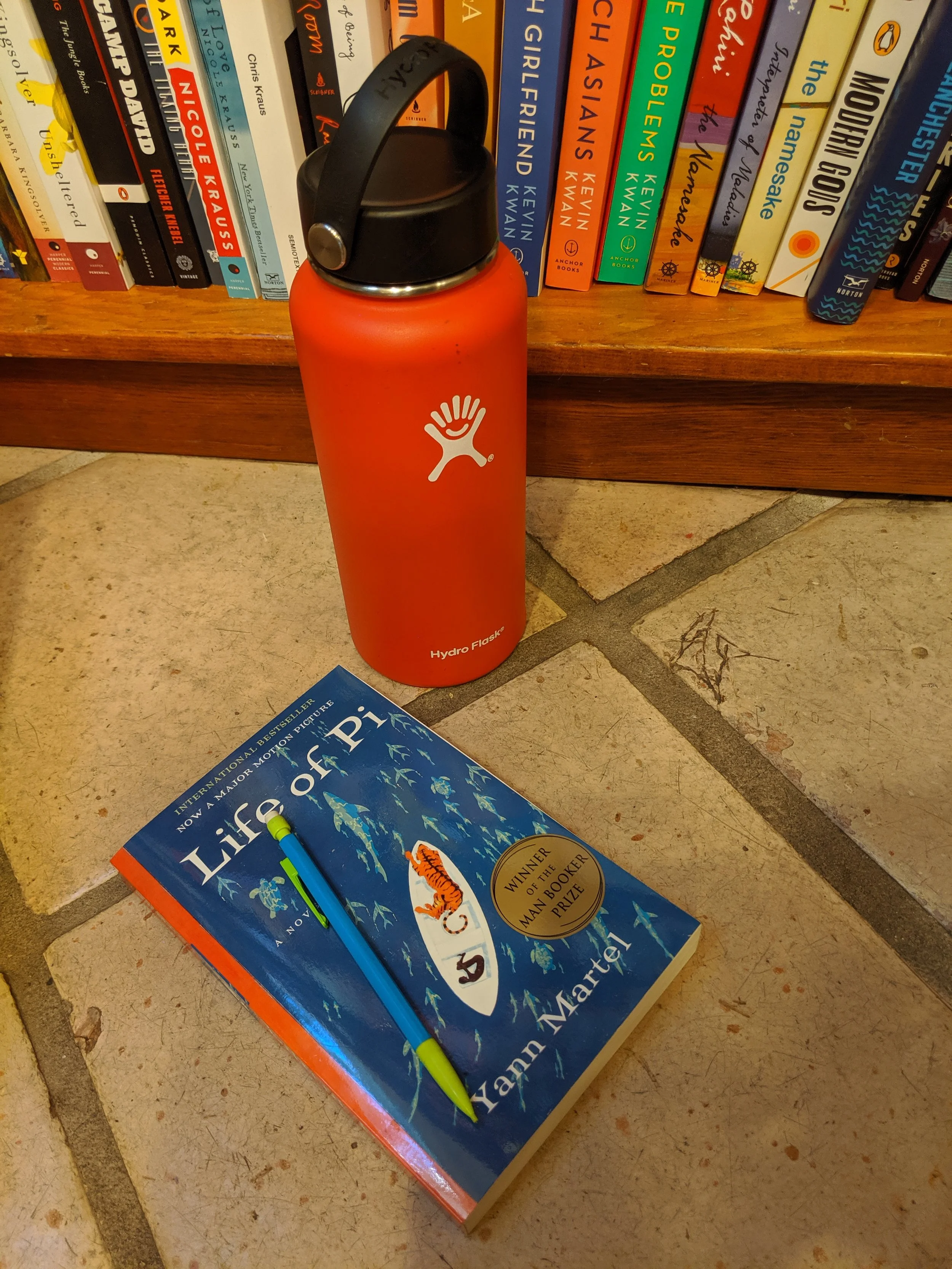
..."If you stumble at mere believability, what are you living for?"... “all life is interdependent, and that we live and breathe via belief”...
The story primarily revolves around the dynamics between five characters - a human boy, Piscine Patel or Pi and his four animals - Hyena, Zebra, Orangutan and a Tiger named Richard Parker. Pi’s father owned a zoo in India before he decided to emigrate to North America along with his animals and his son on a Japanese ship post developments of political instability in the country. The ship meets with an accident in a seastorm around the Philippines, all died except these five individuals who find themselves together on a lifeboat after the shipwreck. It’s a game of power play to survive and the weaker one at the mercy of the more powerful one. Eventually three animals get eliminated but the final game is between the boy Pi and his tiger Richard Parker who realize that they need each other to survive. The book from that point is a muted conversation between the boy Pi, and the tiger Richard Parker and how both of them overcome their physical needs and hunger and use each other to come alive in the end. The book ends with a twist and leaves the reader with many interpretations of the story.
Born in Spain to Canadian French parents, this was Yann Martel’s second novel that rightly won him his Booker prize. Through this story he tries to connect the spiritual side of a human being to its logical side by exploring the concepts of relativity of truth. In that sense the world he creates is more metaphysical and based on the underlying belief that humans live their life based on the stories they create for themselves and the best stories they create are the ones closest to god. The characters are deepened through metaphors used throughout the book and subject to interpretations for the reader. Even the book’s main character is a boy who is named Pi - a symbol deeply spiritual in Mathematics, its value equal to the circumference of a circle divided by its diameter. The number is irrational, infinitely vast and doesn’t hold an absolute value, a theme of relativity of truth that he explores in this book. The five characters could very well be interpreted as your emotions or five senses, all of them interconnected to each other. No right answer, the answer is your interpretation. The book was also later adapted into a movie by a famous Taiwanese director, Ang Lee, which to me is one of the best adaptations I have seen from a book. A visual and spiritual treat to watch the movie as much as intellectually stimulating it is to read the book.
