The Philosophy of Yoga
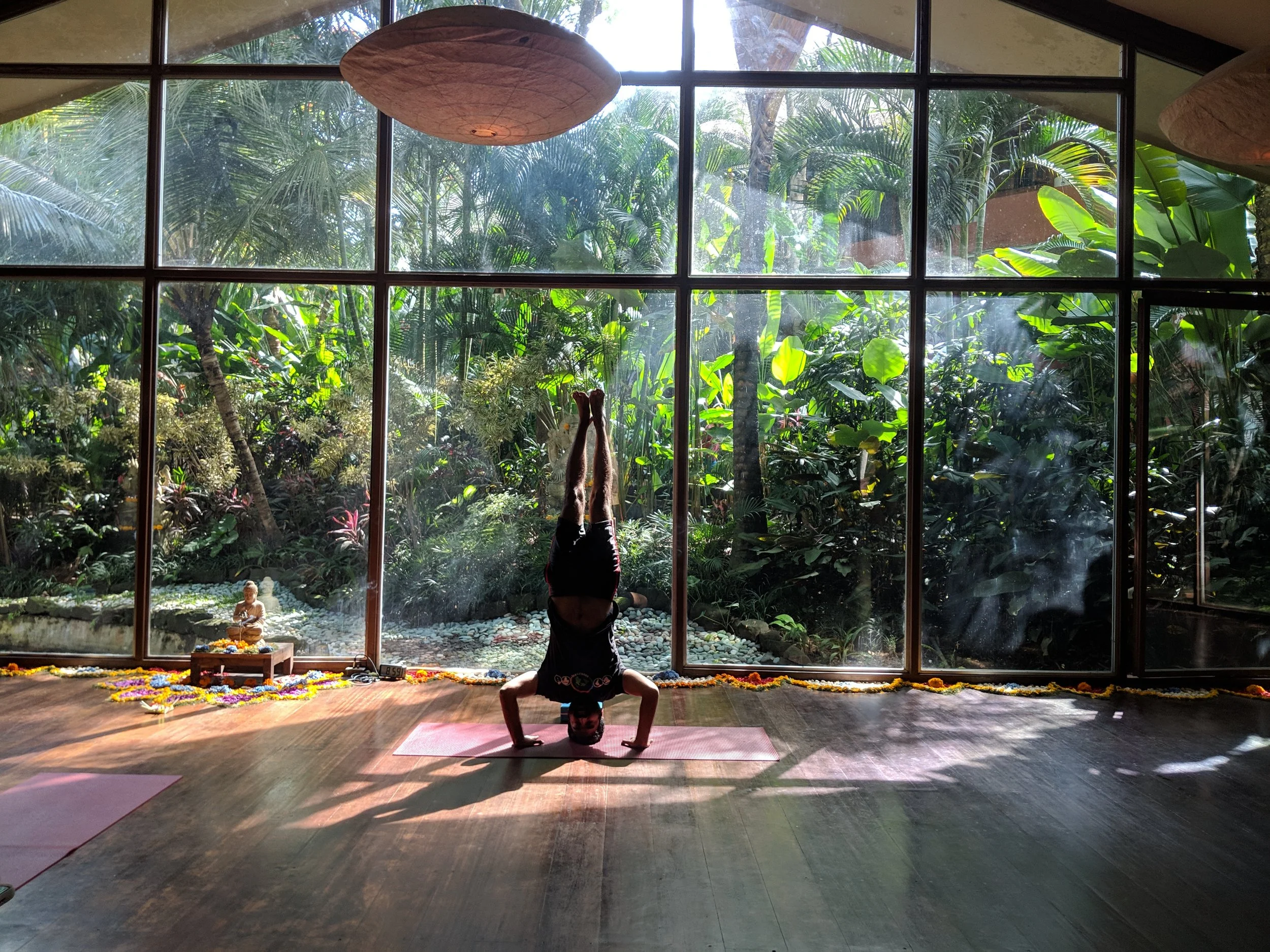
@yoga barn studio, Bali
The Fad
Yoga is a fad these days. I guess no harm as it makes it exciting for the new generation to get introduced to it. Once you get introduced and if you connect with it, your natural curiosity will lead you to go deeper in this practice. The core product offering is strong, so little bit of marketing doesn’t harm and only helps in propagating the bigger good. Typical perception of yoga in western world is the physical practice (or asanas) we do in the fancy studios. Limiting it to just the physical aspect and not understanding the core philosophy is essentially like building a highly sophisticated product with many high end features but your customers benefiting only from one small feature set of this product.
The Inception
Yoga philosophy finds its inception in the 6000 years old Harappan civilization (Indian subcontinent region). Post inception it continuously kept on evolving and got redefined by its practitioners. In that sense this philosophy doesn’t belong to any one faith or individual and truly an open source philosophy. Each individual connects with it in their own unique ways and creates their own practice around it. We all need to define what that path means for us. I feel if a certain philosophy has seen many cycles of life and death and still survived then there must be something deep about it.
The Framework
The core idea in this philosophy is around establishing a framework to lead life and find meaning in it. Life tends to be abstract and meaningless. This search for meaning in life often drives people crazy and that’s where this philosophy can help provide some anchors. When we take a physical shape in this universe (when we are born) we start with a duality “The nature” and “The Soul”. Nature is anything external to our core and our core is where our soul resides. Eventual goal in our life as per this philosophy is to eliminate this duality and merge the soul with nature.
According to this framework, humans need to traverse eight steps to attain their final meaning in life. That’s why this philosophy is also commonly known as Ashtanga (eight limbs) Yoga Philosophy. The eight paths are called - Yama, Niyama, Asana, Pranayama, Pratihara, Dharana, Dhyana and Samadhi. As body limbs are connected to each other and grow concurrently, similarly, these eight paths are not necessarily sequential. Even though for most people, the last three steps are impossible to hit in one lifetime and come only by mastering the first five ones. This philosophy believes in rebirth and says that you go through many cycles of birth and death (sometimes in millions) to achieve mastery and reach your final step.
The 8 Steps
There are eight key steps in this philosophy (not going into details as they are ocean deep concepts in their own). You start from a place outside you and go deeper in your core inner self with each next step. With mastery of each step you untap a lot of spiritual energy which is very powerful. So the responsibility lies on the seeker to not misuse the newly discovered energy else it can be easily directed towards hedonistic pleasure.
Yama - Guidelines around dealing with others.
Niyama - Guidelines around dealing with self.
Asana - Significance around keeping a healthy body by physical practice.
Pranayam - Guidelines around preservation of "Prana" - the vital body energy unit by going deeper in your breathing practice.
Pratihara - Loosening the interconnection between mind and senses and moving towards attaining true freedom.
Dharana - Practice of meditation and understanding your core by focusing on one point.
Dhyana - Deeper practice of meditation and understanding your core by focusing on nullness
Samadhi - And finally the attainment of a supernatural state by eliminating the duality between your soul and the nature you live in.
The Convergence
I also found a deep connection between theories laid out in Physics with Yoga philosophy. Very interestingly both philosophies converge in many interesting ways. Einstein’s Theory of relativity says if you run at a speed of light, you become infinitesimally large and time comes to a stand still. Practically it seems impossible but theoretically that scenario still exists. If you try to map it with the final eighth state in yoga philosophy - Samadhi Phase, it indeed talks about this oneness, where you move away from the domain of any intellect, eliminate duality and merge with the one. You can call it blackhole or the dot or the starting point or the end or state of Nirvana. Guess doesn’t matter. Also it appears that most physicists are also deeply philosophical and spiritual.
The Starting Point
If you are a beginner, many people get confused on how to start and which yoga studio to join or how to learn Yoga. Based on my very limited experience I feel it doesn’t matter. If you are curious, get on the bus (or yoga mat in this case), gain familiarity with the starting point which is the physical practice, start practicing patiently and then trust your gut to guide the right path for you in this journey. You will be naturally attracted to some themes and they may change with your age and experience. Observe them and introspect around them and let your body and mind guide you on further next steps. In that sense you just need to listen to yourself and be a follower of self.
The Yoga Mat Practice
Listing down a few names of the yoga Asana practices that I have heard and my understanding of them. There are many other names but listing down only the more famous ones. This is purely my understanding as of now and I may need to keep revising it as I learn more.
Ashtanga Yoga (the real meaning): I see this as the superset definition of any yoga practiced in the world. It is themed around eight steps of philosophy discussed above. Along with the physical steps to keep you fit and healthy, if you start incorporating the deeper philosophy in your lifestyle, then whatever you are doing, in essence you are practicing Ashtanga Yoga. Some people may also refer to it as Patanjali Yoga as Patanjali was the scholar who consolidated and documented the philosophy in 198 verses in a book.
Ashtanga Yoga as known today (or Mysore Yoga or Ashtanga Vinyasa Yoga): In today’s times, Ashtanga yoga is typically associated with the school of yoga started by K. Pattabhi Jois in Indian city Mysore. He was a disciple of Tirumalai Krishnamacharya, a well respected yoga guru who reignited the whole yoga movement in the 20th century. Even though K. Pattabhi Jois himself got into a few controversies later in his life, but this practice is based on a fixed sequence of surya namaskars and standing sequences. Typically you are supposed to memorize the sequence and practice on your own in a room filled with other fellow students without the active help of a teacher. The teacher if present, looks and observes you and corrects your mistakes.
Vinyasa Krama Yoga: The most common yoga practice in the western world. Comes from a Sanskrit word "Vi+Nyasa+Krama". Translates to "In a special way + To Place + Sequence" or "To practice a sequence in a special way". Typically you don't hold on to the poses longer but follow steps and align your breath in/ out with that sequence. These steps are also aimed at arranging in a way that manages poses and counterposes to balance out the dual effects.
Iyengar Yoga: Started by BKS Iyengar school of Yoga. BKS Iyengar like K. Pattabhi Jois was also a student of Tirumalai Krishnamacharya (father of modern age yoga). Don’t think the teacher called it Iyengar yoga but his students have evangelized this school of Yoga. Definitely a very deep tradition and a lot of authenticity attached with this style. BKS Iyengar’s body was not perfectly aligned so he invested a lot in developing the alignment in his body. Use of ropes/ props etc to go deeper into poses. You stay in poses longer and complete cycles of inhalation/ exhalation/ extension in each of the poses. You leverage breath and its energy (prana) to go deeper in your practices.
Ha-Tha or Yin Yang Yoga: Two meanings attached with Hatha. One is a literal translation - willful or forceful. The other is the union of two words - Ha (Sun) and Tha (Moon). Baked in the philosophy of matching duality. Each pose is balanced by it’s counterpose. Yin Yang is just an English name of Ha-tha yoga. Idea is that in this practice you are aiming for creating the balance. You are striking a balance between your sun energy (masculine, action driven) and the moon energy (feminine, romantic). The first half is generally heat generating phase and the second half of the class is focused more around restoring the energy back.
Yin Yoga: Feminine version of yoga. More restorative in nature without any active energy inducing muscle building steps. Associated with deep stretches and breathing into each of them for 5-10 minutes thereby letting gravity and your breath do all the work without actively pushing your body. Some teachers have also converted this style into a feminine energy dance flow yoga based on their own interpretations.
Yoga Nidra: Generally practice either after a rigorous physical work out or towards the end of the day. Idea is to induce you into a deep sleep where your body gets healed both emotionally and physically. You meditate, sit in very mild poses and eventually go into deep sleep.
Kundalini Yoga: Another school of Yoga that believes that there are seven key chakras (or energy centers) in your body. Through different styles and patterns of breathing you unlock these energy centers and with the released energy you wash away your fears and stress and past impressions.
Nada Yoga: School of yoga that lays a lot of emphasis on sound. Om is a Sanskrit word which consists of three letters (A, U, M). A is the starting letter and M the ending letter in Sanskrit alphabet. So the philosophy is that you cover the distance of creation and destruction when you sing Aum (OM). The sound of Om is generally considered very sacred in Hinduism philosophy. Most of the sound patterns are focused around this sound. You heal your body and go deeper using this sound. Tibetan bowl meditation and other sound techniques may fall under this branch of yoga.
Tantra Yoga: Lately getting associated more around tapping into your inner sexual energies but that’s not the true meaning around it. Tantra is a sanskrit word that means “technique”. Idea is to just play around your energy chakras and give your body energy (or prana) some specific direction in your body. That specific direction can be aimed towards accomplishing a specific goal.
Vipassana Meditation Practice: Primarily attributed to Buddhist arm of philosophy but if you see it’s actually part of the similar Ashtanga philosophy. Goal is to quieten your mind through utmost silence. Many of the sessions are quite intense where you sit doing nothing but meditating for 10 days. Utter silence helps you go through your past Samskaras (or life impressions) and you get a better hold on your senses.
Long tail - Heated Yoga/ Power Yoga/ Bikram Yoga/ Baptiste Yoga et al: The yoga philosophy is open source. Hence so many versions which may not necessarily fall in the domain of yoga but exploited by modern age yoga capitalists. The core product source is so strong that any version of it ends up making sense and providing a lot of value to its practitioners. Bootcamp-ish approach to yoga and focus is purely on physical fitness and toning your body. The studios are typically heated to almost 100- 120 degrees and then some fast paced sequences. Some people love it as they love getting challenged. The sweat and the heat provide that challenge. Some argue it's harmful for the body in the long run but again only those people who have done it for years can comment more. If it works it works I guess.
Disclaimer: I am no expert in yoga. These are just my thoughts which may or may not be accurate.
