Mind Master: Winning Lessons from a Champion's LifeBook by Vishy Anand and Viswanathan Anand
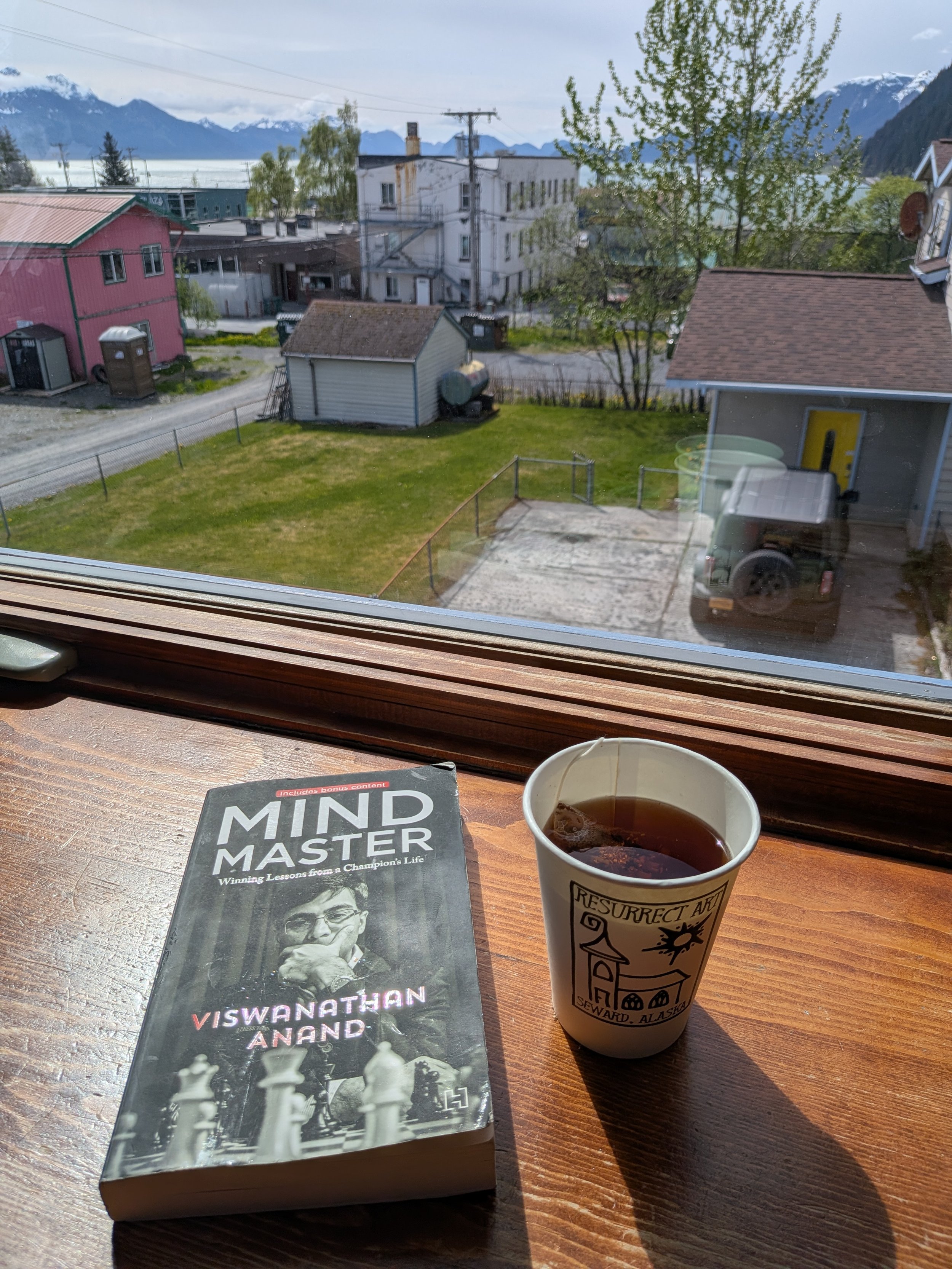
@Resurrection Coffee Art House, Seward, Alaska
My love for chess started when I was a child. We lived in a joint family, and my uncle, a fatherly figure who was also a math teacher, laid the foundation for my interest in the game. I secretly nurtured this passion and eventually played in the finals of a local tournament in a community where students from 200 apartments participated. I lost the finals and came home crying. That memory is still embedded in my mind—that sweet pain you feel when you are so close to winning. While my love for the game never went much further as I got busy with academics and life, I have always appreciated the mental stimulation it provides. If you get into it, it is like a video game: addictive, holding you in its grip.
I picked up Viswanathan Anand’s autobiography out of curiosity and learned so much about him and his background. The book is a fitting tribute to his legacy. For kids of the 80s, Anand is a household name. He was a pioneer in so many ways—the first Indian Grandmaster, the first Indian to win the World Cup, and a player who defended his World Championship title five times (only three other players have defended it six times in modern chess history). On top of that, he has consistently ranked in the top 10 for the last three decades, continually reinventing himself with time.
Being the pioneer, especially in an 80s Indian ecosystem that didn’t naturally support risk-taking outside science and engineering for middle-income households, was extraordinary. To hit such milestones and stay at the pinnacle of his field is no easy feat. The journey to compete at the world level typically starts when you are a child and spans the next twenty to thirty years.
Sometimes, the sacrifices and dedication of parents and family members aren't as obvious when we follow famous figures, yet they deserve equal or even greater recognition. Success belongs to the individual, but the sacrifices belong to the parents, who dedicate the prime of their lives to building a foundation for their children through discipline, consistency, and commitment. And then, these parents selflessly step back, letting their love carry the light forward through their kids.
Reading this book and reflecting on the occasional games I play online or with my friends made me realize how much chess strategies have evolved over the last three decades. This game is far from static. While the core rules of the game haven't changed much in the last two hundred years, the strategies players deploy keep changing with the prevalent spirit of time, which makes chess a dynamic mix of memorization and creative play. At lower skill levels, it may be split equally between memorization and creativity, but at higher levels, memorization takes the driver's seat. Yet, creativity remains crucial—a single innovative move can alter the outcome of an entire game. Even within a single chess game, the opening sequences (the first 20–30 moves) and the endgame rely heavily on memorized patterns, whereas the middlegame is where pure creativity thrives.
Through this, I also realized that chess is largely a game of memorization. The principle is simple: the more you play, the more patterns you store, and the better you can predict and strategize. This book also sparked my curiosity about how one becomes a World Champion versus a Grandmaster. They are distinct milestones. Being a Grandmaster is independent of winning a World Championship; you can hold the Grandmaster title your entire life without ever winning a World Championship. However, under modern regulations, it is practically impossible to become a World Champion without first becoming a Grandmaster. To put this in perspective, there are roughly 2,000 Grandmasters worldwide at any given time, but only one World Champion crowned every two years.
To earn the Grandmaster title, there are strict requirements. A player must reach a minimum rating of 2500 and achieve specific performance norms in international tournaments featuring high-caliber competitors. FIDE, the governing body of international chess, calculates these ratings using a mathematical model: the Elo Rating system. The concept behind Elo rating is simple—if you play against a stronger player and lose, you are not penalized that much in ratings, but if you lose against a weaker player (lower rating), your score drops drastically. This rating system is famous because it eliminates bias and auto-corrects itself to measure your true value over time.
Fascinatingly, this Elo system is now ubiquitous across competitive gaming, and it has become the exact basis for how frontier LLM and AI models are evaluated today. This explains why machine learning researchers leveraged games like Chess and Go to train early AI models. In fact, LLMs and modern AI have advanced so much that we can see parallels between AI scaling laws and human learning. For instance, machine learning scaling laws apply remarkably well to chess: with more computation, expanded memory, and longer training time, the output improves exponentially.
Popular theory suggests that if you devote 10,000 hours to a discipline, your skill level will improve drastically. This makes me wonder: is domain excellence purely a function of the time you commit? If you possess the dedication to pursue something long enough, will success and recognition automatically follow? To put a 10,000-hour commitment into perspective, if you dedicate 2 hours daily, it takes roughly 14 years to build that level of mastery. Hence, at some point, humans are left with a choice: either take the risk and fully commit to it as a lifelong career where the rewards may be higher, or take a more diversified approach and stick to conventional paths where outcomes are more predictable and rewards are a bit subdued.
