Song of the Clay Pot: My Journey with the Ghatam by Sumana Chandrashekar
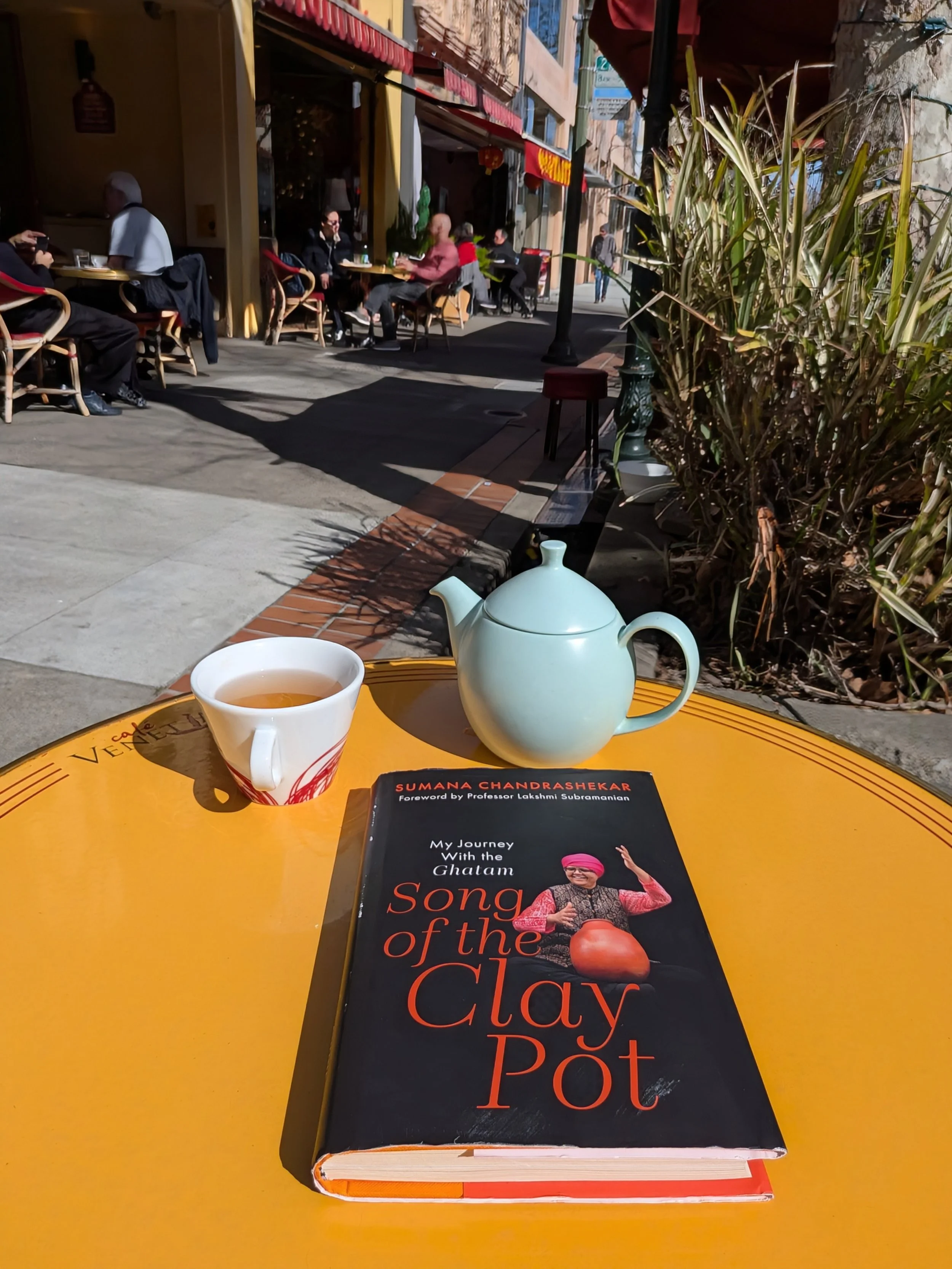
@venetia cafe, Palo Alto, California
Continuing my tradition of picking books that aren't celebrated on social media, I randomly grabbed this one from Bahrisons, my go-to bookstore in Khan Market, Delhi. I had never heard of the author, nor had I ever followed her music. But what a treat this book turned out to be. She writes beautifully and metaphorically. I gained so much respect for her, despite never having heard of her or her work before opening these pages. It is a deceptively simple read that keeps pulling you back in, even when life gets busy.
It is an autobiographical account of a South Indian, female “Ghatam” player, Sumana Chandrashekhar, who challenged the norms in the percussion music scene still dominated by males. The Ghatam is a clay pot with a narrow mouth, built in a highly specific way. A tremendous amount of skill goes into crafting the right instrument, and they are manufactured in only a few places in India—most famously in Manamadurai, near Madurai in the south. The making of this pot is an art form in itself, passed down through generations. In fact, an highly acclaimed Sangeet Natak Akademi award was recently conferred upon Meenakshi Amma, a traditional maker whose family has kept this heritage alive. While the Ghatam finds its roots in Indian folk music, it now features prominently on global stages across fusion, jazz, and rock genres.
Sumana depicts a life that feels deeply Indian, allowing the inherent loneliness of an artist to shine through. Musicians are often deeply spiritual and philosophical, which is evident in her writing. Sprinkling philosophy over the pursuit of a lifelong career as a percussionist, she writes from the heart of her lived moments—with love and romance in her eyes. She challenges systemic norms, yet stops short of sounding bitter like many modern activists do. Early health challenges taught her humility, grounding her perspective. Her writing is unbiased, uplifting, and beautiful in many subtle ways. It presents a vision for a life that can be earthy, grounded, intelligent, curious, and vulnerable—almost as if she lived in a shielded world guided entirely by intuition. Far removed from modern, Western, material definitions of success, her path exists on a different tangent, proving equally rewarding in intangible ways that are celebrated in niche corners.
After finishing the book, I was left wondering what path I should carve for myself in this current phase of life, where I feel God has been incredibly kind and given me an abundance of resources. When you have the luxury of choice, these are the moments to think about what steps will truly fulfill you in the future. This book ignites that exact energy. It offers moments to pause, reflect, be overwhelmed with emotion, and feel alive. It added to my stream of thoughts, validating my own approach to life while giving me the ammunition to pause, sit with my emotions, and guide myself forward. As long as we are human, we will continue to derive our purpose from what we feel. As soon as we transition to a society where we coexist alongside non-humans, machines, and robots, a different set of rules will follow - rules of power will flow differently. But that kind of society is still many, many years away. Until then, we can enjoy books like this and simply feel more human.
